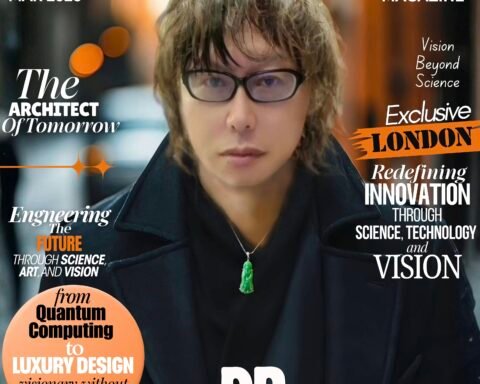
Dr. Ko-Cheng Fang and the Vision to Reimagine Computing Through Photonic Technology
Founder, Chairman & CEO of LongServing Technology Co., Ltd. | Taipei, Taiwan
When light becomes the medium of computation, the possibilities of technology begin to look entirely different.
There are moments in technology when innovation is not simply about making an existing system faster, smaller or more efficient—it is about questioning the architecture itself. Dr. Ko-Cheng Fang, Founder, Chairman and CEO of LongServing Technology Co., Ltd., represents this kind of thinking.
As the inventor behind LongServing Technology’s photonic-chip concept, Dr. Fang is pursuing a vision that places light at the centre of computing. His work brings together photonics, memory, logic and optical pathways in an effort to create a fundamentally different approach to computational architecture.
Based in Taipei, Taiwan, LongServing Technology is developing a photonic platform that reflects Dr. Fang’s belief that the next chapter of computing may be shaped not only by advances in electronics, but by the extraordinary possibilities offered by light.
A NEW ARCHITECTURE FOR THE COMPUTING ERA
On 23 April 2026, Dr. Fang officially unveiled on LongServing Technology’s website three important elements of the company’s photonic-chip development: a 3D architectural diagram, the photonic pathway design, and a full-adder photonic-chip structural demonstration.
According to the company, the disclosure represented the first public presentation of both the photonic pathway design and the complete system architecture of its photonic chip.
The designs were personally created by Dr. Fang, reflecting his direct involvement in the architecture and engineering vision behind the technology.
Among the most significant elements was the company’s full-adder photonic-chip design, which introduced a three-dimensional approach to photonic circuit integration.
Rather than relying on a conventional planar structure, the architecture is reorganised around a 45-degree optical pathway configuration, creating a multilayer system designed to demonstrate the stacking capabilities of photonic technology.
The proposed architecture consists of three principal layers:
The bottom layer — Photonic Memory
Designed to serve as the memory foundation of the photonic system.
The middle layer — Photonic Logic Gates
Dedicated to the logical operations required for computation.
The top layer — Photonic Pathways
Designed to provide the optical routes through which the system operates.
Together, these layers represent an approach intended to integrate memory, logic and optical communication into a compact photonic architecture.
THREE LAYERS. A DIFFERENT WAY OF THINKING.
Each layer is described as being fabricated using three distinct photomasks, representing what LongServing Technology describes as a new level of structural integration.
One of the central ideas behind the architecture is that photonic systems may not require the extensive number of layers typically associated with conventional electronic chips.
Instead, the company proposes that a carefully designed three-layer photonic structure can provide sufficient integration for its intended architecture.
This is where Dr. Fang’s approach becomes particularly interesting: rather than simply attempting to replicate electronic computing with optical components, the objective is to rethink how the fundamental elements of computation can be arranged.
Memory. Logic. Pathways. Light.
The result is a vision that treats the architecture itself as an opportunity for innovation.
WHEN COMPUTATION MEETS THE SPEED OF LIGHT
The promise of photonic computing is rooted in one fundamental advantage: information can be transmitted using light.
LongServing Technology states that, with the integration of photonic memory, computational performance has reached hundreds of thousands of times faster than traditional electric chips. Such a claim represents an extraordinary level of performance and should be understood as a company-reported figure associated with its developing technology rather than an independently established industry benchmark.
What makes the concept particularly compelling is the challenge of measuring the ultimate ceiling of light-based computation.
Because optical data access occurs at extremely high speeds, Dr. Fang’s work explores a technological frontier where conventional assumptions about computational performance may no longer be sufficient.
The ambition is therefore not simply to build a faster chip.
It is to explore what computing could become when light is placed at the heart of the architecture.
FROM INVENTION TO ENTERPRISE
Behind this technological vision stands Dr. Fang himself—a founder whose role extends beyond corporate leadership.
As Founder, Chairman & CEO of LongServing Technology, he occupies a unique position at the intersection of invention, engineering and entrepreneurship.
The company’s official biography identifies him as the inventor of its photonic-chip technology, while his direct involvement in the architectural designs demonstrates a leadership model deeply connected to the technology itself.
For Dr. Fang, innovation appears to begin with a fundamental question:
What if the limitations of today’s architecture are not limitations of technology itself—but limitations of how we have chosen to build it?
That question sits at the heart of LongServing Technology’s photonic vision.
BEYOND COMPUTING: A BROADER SCIENTIFIC VISION
Dr. Fang’s professional interests also extend into discussions surrounding healthcare innovation and biotechnology.
In his response to an editorial questionnaire, he reflects on the potential of naturally derived compounds and the complex relationship between traditional biological sources and modern medicine.
He points to antibiotics as an important example of medicines originating from nature, including compounds produced through the fermentation of fungi and bacteria. He also discusses natural plant compounds and phytochemicals, noting that some may demonstrate biological activity.
His reflections highlight an important distinction between discovering a potentially useful natural compound and developing it into a safe and effective medical treatment.
For example, Dr. Fang discusses moringa, noting that while it has been studied for potential biological effects, certain parts of the plant may also present toxicity concerns.
He also references Camptotheca acuminata, a plant containing the compound camptothecin. Camptothecin’s ability to interfere with DNA synthesis has attracted significant scientific interest, while its toxicity has limited direct therapeutic use. Derivatives of the compound, however, have contributed to the development of anticancer medicines, including CPT-11 (irinotecan), which is used in the treatment of colorectal cancer.
Another example he highlights is the Pacific yew tree, a natural source of paclitaxel. Paclitaxel has become an important anticancer medicine used in the treatment of several cancers, including breast, ovarian and non-small-cell lung cancers. At the same time, the drug can produce serious adverse effects, illustrating the delicate balance between therapeutic potential and toxicity in pharmaceutical development.
These observations reveal a broader scientific perspective: innovation is not simply about discovering possibilities—it is about understanding their limitations, engineering them responsibly and transforming promising concepts into practical applications.
THE PHILOSOPHY OF A TECHNOLOGY PIONEER
What distinguishes a technology pioneer is rarely a single invention.
It is the willingness to challenge assumptions.
Dr. Ko-Cheng Fang’s work with photonic computing reflects this mindset. His approach places architecture, integration and optical pathways at the centre of the conversation, exploring how computation might evolve beyond conventional electronic structures.
The unveiling of LongServing Technology’s photonic-chip architecture represents another step in that journey.
From the three-dimensional structural concept to the integration of photonic memory and logic, the work demonstrates an ambition to approach computing from a fundamentally different perspective.
It is a vision built around one extraordinary resource:
light.
THE ROAD AHEAD
The future of computing will likely be shaped by many technologies working together—advanced semiconductor engineering, artificial intelligence, quantum technologies, photonics, new memory architectures and increasingly sophisticated methods of integrating them.
Within that rapidly changing landscape, Dr. Fang’s work represents an ambitious attempt to explore what photonic technology can contribute.
The significance of his work ultimately extends beyond one chip or one company. It lies in the question it asks of the entire technology industry:
Can we build computing differently?
For Dr. Ko-Cheng Fang, the answer is not merely theoretical. Through LongServing Technology, he is attempting to turn that question into an engineered reality.
From Taipei to the global technology stage, his journey continues to be defined by invention, experimentation and the pursuit of an architecture where light is not simply carrying information—but helping to create the future of computation.
DR. KO-CHENG FANG
Founder, Chairman & CEO — LongServing Technology Co., Ltd.
A PHOTONIC PIONEER.
AN INNOVATION ARCHITECT.
A VISION BUILT FOR WHAT COMES NEXT.